
The National Cancer Plan has been released today, 4th February 2026
Today Wednesday 4 February the Government published its National Cancer Plan.
Our Medical Director Susannah Penney and Managing Director Claire O’Rourke have blogged about how Greater Manchester Cancer Alliance will play a crucial role in delivering this plan.
The NHS Cancer Plan was published today on World Cancer Day. It is a plan set to transform cancer treatment, prevention and diagnosis and make England a world-leader in cancer survival.
The plan focuses on three main strands: diagnosing cancer earlier and at greater scale; restoring and sustaining performance against cancer standards; and delivering more personalised, people-centred care, including better support for those living with and beyond cancer. There’s also an emphasis on pace, consistency and partnership.
The Government makes it clear that England’s 20 Cancer Alliances, of which Greater Manchester Cancer Alliance is one, will be critical system leaders making this change happen and that our role will be strengthened. They want us to take on a bigger role driving change in early diagnosis, working with our partners in the regions around their performance and to roll out innovation and good practice.
We’ll increase the role we play in increasing uptake in cancer screening, with the plan calling for Alliances to work with local communities, screening commissioners, and providers to develop targeted local campaigns to reduce the gap in screening uptake between the most and least deprived areas and to increase uptake in ethnic minority and underserved communities. There will also be more of a role for Cancer Alliances to help improve cancer prevention. With over one third of cancer linked to lifestyle factors such as UV exposure, smoking, excessive drinking or lack of exercise this is something we are excited to be more involved in and an area where we see real potential to make change happen. With 1 in 2 of us likely to get cancer in our lifetime this work is vital.
In Greater Manchester we are excited by this plan and well-placed to drive these changes. We’re also proud to see that some of our innovative work to fast-track cancer tests through our single queue digital platform and better recording of people who get metastatic cancer as examples of good practice. The plan calls for these to now be replicated across England and help reduce variation.
So what does the plan mean for Greater Manchester?
The plan places a strong emphasis on targeting action in communities where outcomes are poorest and making better use of data, innovation and genomics to support earlier diagnosis and more tailored treatment. We’ll be embracing innovation but also working hard to ensure we are not going to leave those who are not digitally enabled behind and that they will still be supported.
In Greater Manchester, we already collaborate with many partners including patients and carers with lived experience, and colleagues from the Voluntary, Community, Faith and Social Enterprise (VCFSE) sector, Primary Care, NHS Trusts, Integrated Care Partnership, local council, and universities.
We continue to work closely with our Cancer Voices Community, made up of almost 100 people who have lived experience of cancer as a patient or a carer. They influence at all levels, from boards to smaller focus groups, ensuring all cancer care improvement projects are designed with and for the people that they serve.
The plan makes it clear this patient power is a golden thread that should run through all our work. We are confident that our strong partnership with patients, carers and community members will continue to evolve, and enable their views and experience to drive change.
Greater Manchester leading the way

Our single queue digital platform has already saved 17,000 days of waiting for all patients referred for some specialist lung tests in Greater Manchester
The plan talks of us being in the foothills of an unprecedented revolution in cancer and technology. Greater Manchester’s bespoke single queue digital platform, connecting the Trusts in Greater Manchester and Mid and East Cheshire, is standardising referral processes and enabling equity of access for patients to specialist tests for lung cancer across the whole region. Instead of waiting for an available appointment at their nearest hospital, patients can bypass these waits and choose an earlier clinically appropriate appointment at another hospital in the region at a time that suits them. It means wait times for specialist lung diagnostics were up to 60% shorter than they were before single queue was first piloted, the equivalent of up to five fewer days for patients waiting for tests. This saved over 17,000 days of waiting for all patients referred via single queue diagnostics for these specialist tests in Greater Manchester. This work is now informing Government plans for hundreds of thousands more cancer patients to be diagnosed and treated quicker by 2030.
Embracing research and innovation
Research and Artificial Intelligence (AI) will also be an enabler to delivering the plan. In Greater Manchester our Alliance has rolled out an AI-tool to read chest x-rays and speed up lung cancer diagnosis at seven NHS Trusts. We’ll shortly be piloting using AI to help radiologists read prostate MRIs too. In this way we hope AI can help staff achieve more and free up ‘time to care’ for our workforce.
Alliances will be instrumental in helping scale up new self-referral pathways which take patients straight to testing without having a GP appointment, to speed up or rule out a cancer diagnosis. In Greater Manchester our Alliance worked with the Northern Care Alliance to trial a self-referral to chest x-ray pathway for patients with a persistent cough. This is soon to be rolled out further in Greater Manchester. And we also hope to begin a new self-referral for postmenopausal bleeding pathway later this year.
Many of these initiatives have been developed thanks to our close working relationship with the Greater Manchester Diagnostic Network. Last year our Managing Director Claire O’Rourke also became Managing Director for Greater Manchester Diagnostic Network. This is allowing us to work more closely together on many diagnostic initiatives and will allow us to look at more innovative ways forward powered by partnership.
Empowering patients via technology is a big theme of the plan too with new strategies including advances in genomics, wearables and diagnostics in the community, our partnership working with the diagnostic network will place us well to further develop and drive forward change at pace.
Recording metastatic data

We have already introduced the UK’s first metastatic strategy to transform cancer care here in Greater Manchester
Greater Manchester Cancer Alliance, working in partnership with Greater Manchester ICB, has developed an algorithm which is highlighted in the plan. This algorithm scans several datasets within the Greater Manchester Analytical and Data Science Platform, alongside a longitudinal patient record viewer. This approach enables more accurate identification of patients with metastatic breast cancer at a system-wide level, rather than relying on individual provider records. By improving visibility of this patient group, the system creates opportunities to better understand their holistic health needs, patterns of service use, and overall outcomes. In Greater Manchester, we’ve gone further with a UK first metastatic strategy to transform cancer care in Greater Manchester.
Live well with cancer
This brings us to another theme of the plan helping people to live well with and beyond cancer by making sure people have a personalised assessment of need resulting in personal cancer plan that is easily understood and provide a clear basis for on-going neighbourhood care and support. Also we want to ensure very cancer patient will receive an end-of-treatment summary that will, as services develop, help adjust what they need and receive from neighbourhood health services on an ongoing basis. We want to not just cure people but help them ‘live well’ five years after diagnosis or live well if their cancer is not curable. Our Cancer Live Well Programme has helped to bring together support services available across GM as accessing and finding the right support, whether it be about emotional, physical, financial, mental or wider well-being concerns people face during and after cancer can be challenging for patients and their families. Therefore as an Alliance we have been focusing on centralising acute, primary care, charitable, community, voluntary and digital based offers available across GM, by locality and system wide in an easy to use and searchable web based tool.
Aligning with the focus on utilising digital tools we will continue to develop and expand Personalised Stratified Follow-Up (PSFU) pathways across more tumour groups, supported by a digital remote monitoring system to ensure clinically safe tracking of patients post treatment, ensuring they are getting rapid access when needed as well as not attending unnecessary appointments while still being monitored by their clinical teams.
The Cancer Plan talks about an ambition to deliver a universal, digital first prehabilitation offer for all cancer patients given studies that have shown that structured exercise and prehabilitation programmes can both help patients come through treatment more successfully. As an Alliance we have expanded our Live Well Programme to focus on ensuring appropriate triage pathways for patients to enable access to the appropriate level of prehabilitation suited to their individual and clinical needs, while also investing in upskilling community leisure centres and services to provide rehabilitation closer to home post treatment.
We have also funded a pilot project in collaboration with Greater Manchester Mental Health NHS with the aim to improve access into Talking Therapies for those impacted by cancer and a new dedicated pathway has been developed to support individuals to help them understand their mental health challenges and explore new coping strategies. This pilot is providing support for a range of common issues experienced by people affected by cancer, including low mood, anxiety, stress, and difficulties with coping. Addressing these concerns can lead to improved overall wellbeing and quality of life.
Early diagnosis
The plan states that early diagnosis rates for cancer have remained flat and need to improve. In Greater Manchester (60.2%) of cancers were diagnosed at an early stage over a 12-month rolling period (February 2024 – January 2025), placing us:
- above the England average
- 9th out of 20 Cancer Alliances nationally
- 1st in the North West region
Greater Manchester improved by 6.2% compared to a 3.7% increase across England so we are making good progress, with some of the biggest local gains
Lung cancer screening in Greater Manchester is set to reach it’s full roll out later this year – 4 years ahead of target
seen in lung cancer (16.39%), melanoma (13.14%), prostate cancer (4.67%) and gynaecological cancers (3.27%). In 2019, we ranked 15th-17th out of 20. The progress we’ve made since then demonstrates the power of a system-wide approach to early cancer diagnosis and the vital role Cancer Alliances can play in delivering real change.
Earlier and faster diagnosis of cancer is dependent on people understanding and being aware of the early signs and symptoms of cancer, by taking up screening programmes or visiting a healthcare professional. Healthcare professionals must also be aware of and have the tools to hand to ensure a timely referral.
Our vision for the people of Greater Manchester is a future where everyone with cancer receives equitable and timely early diagnosis. By raising public awareness, reducing health inequalities, and fostering collaboration and innovation, we aim for continuous improvement in the proportion of cancers diagnosed at an early stage. We have a strategy to achieve this in Greater Manchester focusing on public symptom awareness, collaboration with primary care, understanding and addressing variation and progressing innovative ways of working.
One of the ways the plan proposes to do this is to roll out NHS lung cancer screening – targeted at those most at risk smokers and former smokers aged 55-74 by 2030. Lung cancer screening helps to detect lung cancer earlier when it is much more treatable. In Greater Manchester we are set to reach full roll out later this year – 4 years ahead of the target. We were the city that started lung cancer screening. The Alliance is now proud to lead the roll out with Manchester University NHS Foundation Trust and the support of the Northern Care Alliance in Greater Manchester. So far this has resulted in over 1,200 cancers found – 78% at an early stage when treatment is much more likely to be successful.
This piece of work shows how the alliance is best placed to drive early diagnosis and implement changes for the whole cancer system in Greater Manchester.
Increasing awareness of cancer in people from deprived backgrounds
The plan finds people from deprived backgrounds are less likely to recognise cancer symptoms and there are different levels of knowledge about genetic
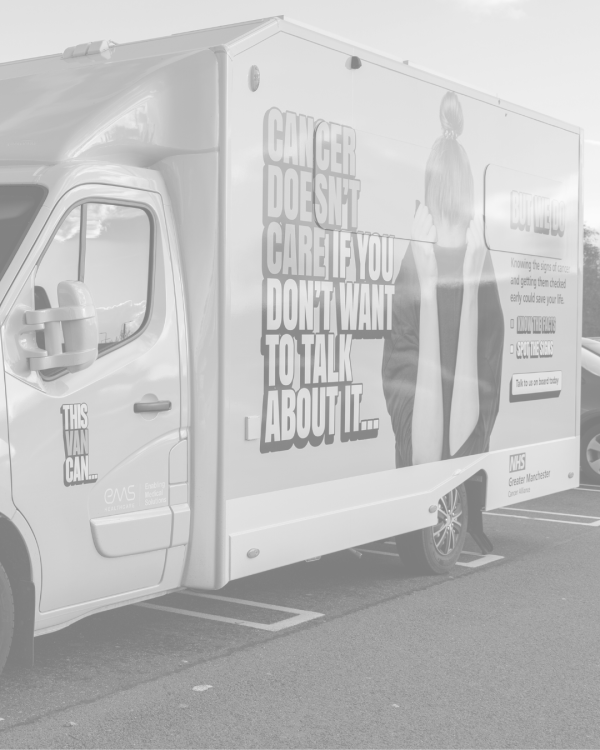
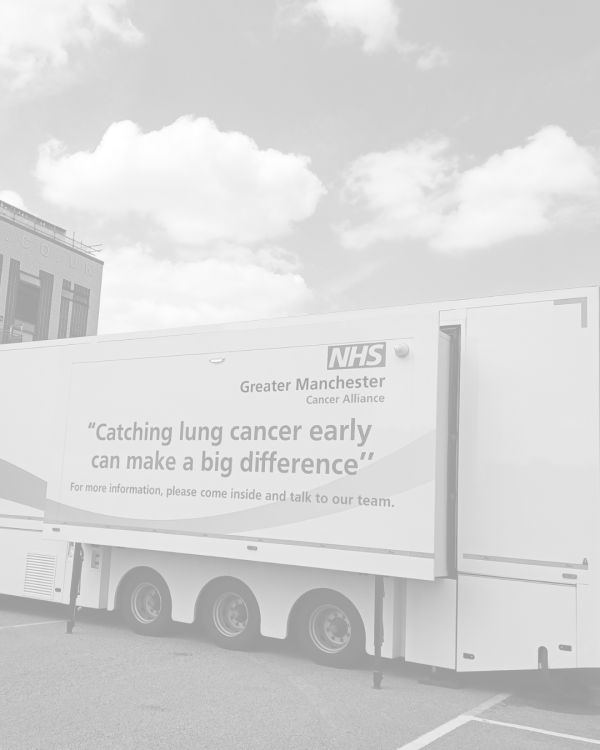
Our “This Van Can” community outreach roadshows are out engaging with people close to where they live
risk and preventable risk factors. That’s why at Greater Manchester Cancer Alliance we’ve been working with the VCSFE sector to develop a series of cancer awareness roadshows to raise awareness of prostate cancer risk, bowel cancer symptoms and how to access screening as well as symptoms of ovarian cancer and now cancer overall. Our ‘ThisVanCan cancer awareness roadshow campaign is targeted at postcodes and areas where cancer early diagnosis rates are at their lowest so we can make the most difference. It’s currently encouraging people to ‘Get Cancer Clever’ and recognise the five most common ‘red flag symptoms of cancer. We loop in with VCSFE stakeholders, GP surgeries and cancer charities to help spread the word. By taking this approach, we can have face-to-face conversations where people are going about their daily lives – often parking at shopping centres or supermarkets and offer physical information for those who are not digitally enabled to access resources. We’re also placing our important messaging, adverts and posters in free community newspapers, community centres and GP surgeries, and working with VCSFE partners ensure important cancer messages get to people in both a digital and non-digital format.
We’ve also worked with women with learning disabilities and autistic women to devise resources that help encourage cervical screening uptake and with women from Black and South Asian communities to develop resources to increase awareness and acceptance of breast cancer screening and going to the GP to check out potential symptoms of breast cancer.
Workforce and education
The plan points to the importance that the current and future workforce must be built on skills, development and retention, not headcount alone, and the Aspirant Cancer Career Education and Development (ACCEND) programme is a key enabler to this. In Greater Manchester we have made significant progress with ACCEND implementation working with providers to embed the three components. We have developed standardised job descriptions, introduced inductions, aspiring CNS programmes, aligned with ACCEND, and co-developed ACCEND standards with key stakeholders, setting out core principles to guide organisations in fully embedding the framework for all non-medical professionals. These standards are designed to ensure that all staff are supported in their continuous professional development.
Our ACCEND framework is about investing in professional development to improve wellbeing and ensuring the cancer workforce accesses continuous professional development to make sure they remain agile to change and have the skills to embrace new technologies.
Central to this is the Greater Manchester ePortfolio hosted on the Cancer Academy, which bridges workforce development and digital innovation by helping staff log learning, capture reflections, evidence impact on practice and revalidate more easily. Alongside this, we have developed a Core Cancer Essentials training package relevant for both generalist and specialist roles in addition to pathway specific education frameworks all aligned to the ACCEND framework, focused on the skills needed to deliver excellent patient care at the right time. This ensures that patients are cared for by confident, capable health and social care professionals with the right expertise at every stage of their cancer pathway. This isn’t just about our cancer workforce but making sure all health and social care professionals understand the core cancer essentials.
Digital innovation is also playing an important role. Beyond reducing administrative burden, we are using technology to deliver more flexible and scalable education, including AI-driven communication skills training. These experiential learning environments allow the workforce to practice and build confidence in a safe, repeatable way, strengthening the communication and decision-making skills that underpin high-quality cancer care.
In summary
Overall we welcome this plan and the decision to strengthen the role of Cancer Alliances to make sure we can deliver the transformation in our cancer delivery model envisaged in this plan. Our local knowledge combined with our cancer expertise, clinical leadership and partnership way of working means we’re already best placed to firmly guide and support local improvement. It’s a comprehensive plan which we’ll be digesting and discussing the best ways forward with partners and patients in the coming weeks and months. With 1 in 2 of us due to get cancer in our lifetime we know there will always be more work to do, and this plan will help us to speed up action and make a difference.