
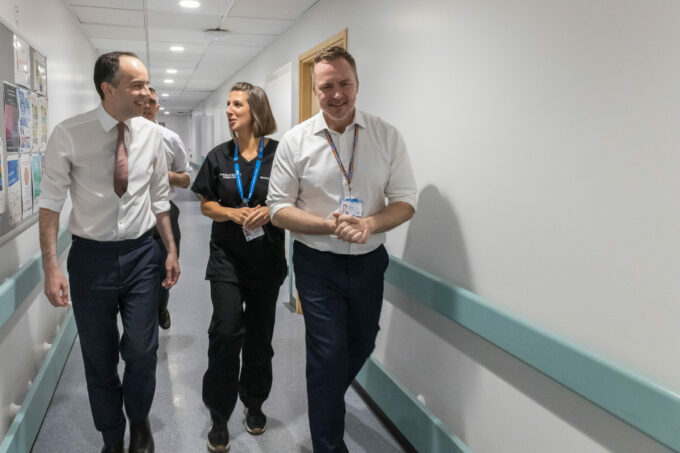
James Murray, Health and Social Care Secretary, has been visiting Wythenshawe Hospital – part of Manchester University NHS Foundation Trust to witness the pioneering work of clinicians using artificial intelligence to detect diseases earlier.
Wythenshawe Hospital is one of a series of hospitals using the new technology in Greater Manchester thanks to the Greater Manchester Chest X-Ray AI pilot which was has been rolled out across seven NHS trusts by Greater Manchester Cancer Alliance.
The pilot demonstrates what can be achieved when partners come together with a shared goal. Through collaboration between Greater Manchester Cancer Alliance, NHS provider organisations and industry partners, we successfully delivered the largest-scale implementation and evaluation of chest X-ray AI in the UK, processing more than 500,000 chest X-rays across Greater Manchester to date.
The project – a UK-first – showed how AI can support earlier identification of findings, prioritise reporting workflows and help patients access diagnostic pathways more quickly. Most importantly, it provided valuable insight into the governance, safety, workforce and implementation considerations needed to adopt AI effectively at scale.
This work – which was led by Dr Rhidian Bramley, Clinical Lead for AI and Lisa Galligan Dawson Director of Performance and Ali Jones Director of Commissioning and Early Diagnosis – highlights the critical role that Cancer Alliances play within the system by bringing together partners to accelerate innovation, share learning and drive improvement across entire pathways. Its success is down to the strength of partnership working and the collective commitment to improving outcomes for patients alike.
Claire O’Rourke, Managing Director at the Greater Manchester Cancer Alliance, said: “As the NHS continues to explore new approaches to reducing waiting times and delivering earlier cancer diagnosis, the lessons from collaborative programmes such as this, led by the Greater Manchester Cancer Alliance, will be increasingly important. Innovation alone is not enough; it is partnership working, shared leadership and system-wide collaboration that turn innovation into impact.”
Dr Anna Sharman and her patient her patient, Peter Allinson. spoke to the Minister about the tool.